|
NEWS
News
from Scotland
RCN SCOTLAND: NOT ENOUGH NURSES ARE BEING RECRUITED.
The Royal College of Nursing
claim that nurses across Scotland fear that understaffing is affecting
patient safety. Jane McCready, chairman of the Royal College of Nursing
Scotland board, told a meeting in Glasgow that the Scottish Executive
was not adequately expanding the workforce to meet patient needs.
Figures from the Nursing and
Midwifery Council (NMC) show 274 fewer nurses registered to work in
Scotland than in 1990 in contrast with an increase in England and Wales.
Jane McCready said:"These figures clearly show that Scotland has still
not recovered from the nurse recruitment crisis of the early 1990s and
this is just not acceptable. "This figure compares poorly with England
and Wales, both of which are experiencing an increase in new nurses”.
The RCN also highlighted
that only 215 more nurses were now working in Scotland compared with
2001 - up from 64,700. Jane McCready added: "At a time when workload is
increasing and the roles taken on by nurses are expanding, an extra 215
nurses is simply not enough to meet patients' needs.
"What's more, these
figures come only a few weeks after the Scottish Executive decided to
cut the number of student nurses from 3955 to 3500." But the Executive
said nurse numbers were at an all-time high. A spokesman said: "We are
not complacent. Measures are in place to ensure we can recruit and
retain even more staff for Scotland's health service. And we have not
cut student nurse recruiting.
News
from The Philippines
Stop exodus of nurses, doctors, WHO urges RP
By Christian V. Esguerra
Inquirer News Service
THE COUNTRY will continue to
lose its doctors and nurses to higher-paying jobs abroad unless a
wide-ranging solution is drawn up soon, a top World Health Organization
(WHO) official said recently.
In the next 15 years, the
United States will be opening its doors to around one million nurses and
this would attract local health professionals, Dr. Jean Marc Olive, WHO
country representative in the Philippines, said. Canada and Europe,
already a favorite destination for Filipino nurses, are also expected to
need "hundreds of thousands" of nurses to fill vacancies in their
respective health care systems, Olive said.
The opportunities might
prove irresistible to local nurses who earn roughly P11,000 or $200 a
month. Salaries for similar workers in developed countries are at least
five times higher. "(The problem) has been existing for many, many years
and it seems now that it's accelerating," Olive told reporters. "There
is no magical solution. The problem links many things." Last week, the
Alliance of Health Workers (AHW) gave the local health care system two
to three years before collapsing due to the unabated exodus of doctors
and nurses for abroad. Olive did not buy the prediction but pointed out
that the problem would "not diminish" considering the steady demand for
nurses in the US, Japan, Saudi Arabia, Europe and the Gulf region. Olive
said the country was essentially faced with the problem of "restricting
the movement" of doctors and nurses driven to go overseas by poor
working conditions and the lack of opportunities here.
"There has to be a lesser
differential between what she earns here and what she earns in the US,"
he said. "(If that happens) maybe people will think better before
leaving home." Olive recalled the experience of Jamaica that lost its
medical professionals who were lured by developed countries like Canada,
United Kingdom and the US. He said there was even a time when the
diaspora had become so widespread that a nursing school was booked by
would-be enrollees one year in advance. He said the school had an
arrangement that sent its graduates to affiliate institutions abroad.
In the Philippines, he said,
one possible solution would be to seek "retribution" from countries
taking in local health professionals. He said it could come in the form
of remuneration given back by the migrating nurse or doctor to the
country. It would be the person's way of acknowledging the local
training he or she got. Olive feared that without measures like this,
even teachers in nursing schools might be enticed to work abroad. "In
the long run, the quality of studies (will suffer)."
Some health officials have
floated the idea of requiring medical graduates to work in the
countryside before leaving for abroad. But others shot it down, saying
it infringed on their right to chart their own career path. Amid the
proposals, Health Secretary Francisco Duque III earlier appealed to the
nurses' "sense of patriotism" in an effort to convince them to stay.
Last week, the AHW said a
number of district hospitals had closed because of the lack of funding
from local governments and the absence of doctors and nurses. In Isabela
province alone, nine hospitals have shut down and two more were expected
to follow suit, the group said.
WARNING to health
authorities: The Philippine health care system will collapse within the
next two to three years as dismal working conditions continue to drive
local doctors and nurses overseas.
The Alliance of Health
Workers (AHW) yesterday made this disturbing prediction, pointing out
that a total of 51,850 nurses left the country for greener pastures
abroad from 2000 to 2003 alone.
This means that the country
lost close to 13,000 nurses every year during that short period,
according to Jossel Ebesate, AHW secretary general and nursing
supervisor at the government-run Philippine General Hospital (PGH).
Worse, he said, more than 5,000 doctors joined the exodus to also work
as nurses abroad from 2000 to 2004, and around 4,000 licensed physicians
were now enrolled in nursing schools.
New 21st
Century Nurse Visitors
This
month
we are pleased to welcome new visitors from Myanmar, Algeria
and Liberia. Welcome to the 21st Century Nurse, we hope you
enjoy your experience! To see information about our other
visitors, please click here:
http://www.21stcenturynurse.com/visitors.htm
Overseas
Nurses Programme Survey Results
Last
month we discussed the New Overseas Nurses Programme (ONP).
To recap:
As
of 1 September 2005, all overseas trained nurses (except those
from within the EEA) wishing to be accepted onto the UK
register, will have to undergo the new Overseas Nurses Programme
(ONP), in order to register as a nurse in the UK. This program
comprises of common entry standards, a compulsory 20-day period
of protected learning for all nurses trained outside the
European Economic Area (EEA) and, where appropriate, a period of
supervised practice.
From
1 September 2005, all overseas applicants (except those from
within the EEA) wishing to apply for registration with the NMC
as a nurse will also have to undertake the IELTS test. The
'academic' module will be a compulsory requirement and students
are expected to achieve a mark of not less than 6 in the writing
and speaking sections and not less than 5.5 in the listening and
reading sections.
In
the past, the NMC has found that the quality of supervised
practice placements varies enormously. The aims of this new
programme are to produce a uniformly high standard for achieving
registration.
**21st Century Nurse Comment**
21st Century
nurse is of the opinion that this new Overseas Nurses Programme is
certainly a step in the right direction as the cold hard facts are:
a. The UK is experiencing a nursing shortage and will continue
to do so for the considerable future.
(Many currently registered nurses are reaching retirement age in
the next few years. A significant proportion of overseas nurses
already on the NMC register here are planning to head to other
countries such as the USA in search of higher salaries. Many UK
trained nurses are also considering options overseas, tempted by
the promise of a better lifestyle and working environment).
b. There are many nurses who were trained overseas who wish to
work in the UK.
Therefore, the Overseas Nurses Programme is aiming to match
vacancies with those seeking employment in a way that ensures
that all applicants experience a uniform quality of induction
and that qualifications are of equally satisfactory standards.
However, let us look at the other facts:
- It
has also recently been reported by a spokesperson at the NMC that
there are currently
37,000 overseas nurses in the UK who are looking for, but
unable to start work as there are not enough Supervised Practice
Placements to match demand.
- The
NMC has reported that they want between 30 and 40 universities to
run the new ONP courses.
- We
estimate that each university will have anywhere between 30-300
admission spaces for the ONP programme to fill per year.
If
we take a mid-range number of say 150 places per year for 40
universities, that results in total ONP places for 6,000
overseas-trained nurses. That would still leave over 30,000
overseas trained nurses who are looking for a placement in the
UK with no places available. According to NMC statistics, in
2004, 11,000 applicants were given a decision letter stating
they needed to find a supervised practice placement. Assuming
that this figure will be around the same this year, there will
be an even greater number of overseas trained nurses in the UK /
considering coming to the UK looking for placements which simply
don't exist.
Each applicant has to pay a fee of £140 to
the NMC for the application to be processed. This means that in
total so far, we estimate that
£4.2 million
(30,000 applicants x £140) has been
paid by applicants who have little chance of gaining a placement
in the UK, with more and more hopeful nurses still continuing to
apply, yet with little chance of success.
21st
Century Nurse receives many emails on a daily basis from those
who are desperately looking for placements in the UK. We also
get many queries from people wondering why the NMC still
continues to process applications, when in fact there is such a
lack of placements available.
We
therefore conducted a short survey last month regarding this
matter so that we can see what you think. Here are the results:
|
We
asked 200 overseas nurses the question:
"Before you applied for NMC registration, did you think"
a.
There were many placements available in the UK,
b.
There are some placements available but it will take a little
time to find one
C.
It is difficult to find a placement.
|
|
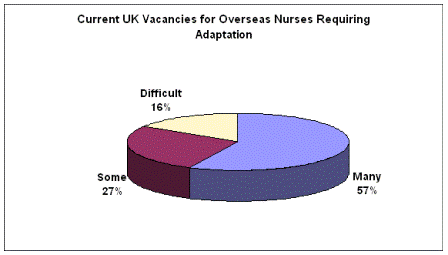
The
results show that the majority of respondents believed prior to
NMC registration that there were many placements for overseas
nurses in the UK, with only 16% of respondents aware that there
are currently limited placements for Overseas Nurses in the UK. |
|
We
also asked 200 overseas nurses the question:
"What are your views regarding the NMC Application process"
a.
They are processing applications in the best way they can.
b.
They should alert applicants more to the difficulties in finding
a placement.
C.
They should not process applications until a placement has been
secured. |
|
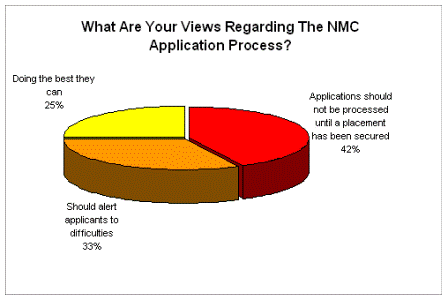
The
results show that the majority of respondents believe now that
the NMC should not accept applications until a placement has
been secured in the UK, followed by 33% of respondents who
believe they should at least be alerted more to the difficulties
in finding a placement. |
These are some of the additional comments we received regarding
these questions:
"The new Overseas Nurses Programme is making it more difficult
to work as an overseas trained nurse in the UK. Already the
grass in the USA is greener in comparison to the UK. Therefore
many nurses will turn their attention away from the UK to the
USA...."
"Nurses from overseas do believe it will be possible to find placements,
why would they think otherwise? There are already many 1,000’s of
overseas nurses already working in the UK. The NMC is not specific and
does not clearly state the true situation that at present exists in the
UK..."
"
The NMC should make sure there is a fair balance between
applications and placements. At the moment it is completely
mismatched and this may lead to a serious nursing crisis in the
UK because most of the nurses who are waiting for placement and
are completely frustrated and going to another country or home.
So in my view NMC should take action without further delay."
"The system the NMC is using is wrong as far as overseas
applicants are concerned. As your commentary pointed out, the
NMC are taking vast amounts of money for nothing. Why is this
wrong? for example, the 140 sterling is the equivalent of 2
months salary for applicants from the Philippines. The system
must change and applicants for registration should only be
accepted if there is a place available for the applicant..."
"I am in the process of applying for my UK nursing registration.
I have just read your article about the NMC Overseas Nursing
Programme. I am Australian and have a "Right to Abode" in my
passport. I lived and worked in the UK previously on a 2
year working holiday. I wanted to do one or two years in the UK
again at some time in the future as an extended working holiday.
It's been a very expensive exercise to discover there are just
not enough places. I actually have a letter from the NMC stating
I only have to do the 20 days protected learning time but am
finding all the universities I have applied to are only
recruiting those that have to do the supervised placement as
well as the protected learning time. If this is the case, why
are the NMC taking the 140 pounds and sending out applications
when they know it's futile? It appears to be a great revenue
making venture and will be sure to be ongoing because nurses
will always have a desire to travel. However, in the long term
the nurse shortage will increase because what average person can
afford the international airfares, accommodation, car hire and
all the other expenses that go with it just to get registered in
the UK? I appreciate their reasons as to why they are
maintaining the professional standards but it in the long term
it may well leave the nurse shortage even shorter."
If
you have any comments on this matter, please email them to
info@21stcenturynurse.com
Return to Top
Philippines
Watch
FIESTA (The Filipino International Emergency Services Training
Association) has launched a new service.
The Philippines is a back
water as far as international news is concerned. Any earthquake in
Europe or volcanic change, for instance, will be reported in the British
papers. However the regularity of earthquakes in the Philippines and the
number of active volcanoes seem to mean that this is no longer news in
the UK. News is something out of the ordinary and the Philippines is a
long way away. Philippine Watch tries to redress this balance.
Philippines Watch is a
new information publication that will come on or near the 1st of the
month each month and special editions will be produced about local
events when and if they happen. It is hoped that this will include
warnings about typhoons that are predicted to affect the Philippines. It
contains information about typhoons in the Philippines area as well as
earthquake and volcano activity.
To receive this free
publication, please email
dalejohno@aol.com
To learn more about
Fiesta, please click here:
http://www.fiestauk.homestead.com/homepage.html
Return to Top
|
Action Against Hunger
This month we would
like to introduce you to Action Against Hunger who are currently
recruiting nurses for the role of Nurse / Nutritionist in
locations around the world.
|
 |
Action Against
Hunger (AAH) is part of the Action Contre la Faim International
Network (ACFIN).
ACFIN is an
international, non-governmental and non-religious organization
who has been at the forefront of the fight against hunger and
malnutrition worldwide for 25 years.Working in emergency
response and longer term assistance in the areas of nutrition,
health, food security, water and sanitation we are regularly
looking for nurses to work in our health programmes and
therapeutic feeding centres. All nurses are given pre departure
training on the nutrition aspects of the programmes run by AAH.
Locations: ACFIN have programmes throughout Africa, Asia
(Southern, Central and Eastern and Caucasus), Southern/Central America
and the Middle East. We are currently working in 40 countries worldwide.
For more information about working for Action
Against Hunger, please check out our Global
Jobs Section or visit
www.aahuk.org
Canada & Ireland
Following on from last
month's survey where we asked which countries you would most like
information about, we are compiling the information you requested. We
are currently working on our Ireland section and following many
requests, we will soon be featuring more information about working in
Canada as a nurse, including registration requirements, hospital
listings, and a directory of associations, recruitment agencies,
immigration companies, events etc.
Return to Top
New Australia
Directory Listings
We are also pleased
to tell you that we have added more information to our ever
popular Australia Directory. Last month we added links for the
Professional Health Bodies in ACT. This month we have added
information about New South Wales. If you are interested in
working in NSW, you should contact these regulatory bodies,
recruitment agencies or emigration specialists who operate in the region who should be
able to advise you further on registration requirements and
possible opportunities. Coming next month, information
about living and working in The
Northern Territory.
Australia Regional Directory
Return to Top
Nursing
Experiences
We have had some
more of you tell us your experiences in the UK and working
internationally. Thank you for
sharing your stories. It is always interesting to hear how
people have adapted to working in a different country and how
the nursing practices differ from country to country.
Please click to read
our latest additions and don't forget to share your stories -
whatever country you work in - we are always interested in
hearing them!
UK
Experiences
Global Experiences
Joke of the
Month
Johnny and his wife
went to the State Fair every year. Every year Johnny would say,
"I'd like to ride in that aeroplane." And every year his wife
would say, "I know, Johnny, but that aeroplane ride costs ten
dollars, and ten dollars is ten dollars." This one year Johnny
and his wife went to the fair and Johnny said, "I'm 71 years
old. If I don't ride that aeroplane this year I may never get
another chance." " That aeroplane ride costs ten dollars, and
ten dollars is ten dollars.", replied his wife. The pilot
overheard them and said, "Folks, I'll make you a deal. I'll take
you both up for a ride. If you can stay quiet for the entire
ride and not say one word, I won't charge you, but if you say
one word it's ten dollars." Johnny and his wife agree and up
they go. The pilot does all kinds of twists and turns, rolls and
dives, but not a word is heard. He does all his tricks over
again, but still not a word. They land and the pilot turns to
Johnny, " I did everything I could think of to get you to yell
out, but you didn't." Johnny replied, "Well, I was gonna say
something when my wife fell out, but ten dollars is ten
dollars."
Return to Top
We hope you enjoyed the 21st Century Nurse Experience. Until next time!
|